Voro FiberOps
A custom map-based production tracking platform I created for underground fiber contractors, built around the real work crews complete in the field.
Voro FiberOps started with a real operational problem inside underground fiber construction, not a product idea looking for a market. Crews complete thousands of feet of conduit and fiber in the field, then lose hours turning that work into redlines, footage totals, and invoices by hand.
I created Voro FiberOps to close that gap. I designed and developed a custom platform built around the actual work being completed in the field, so completed production becomes organized records the moment a crew logs it.
Overview
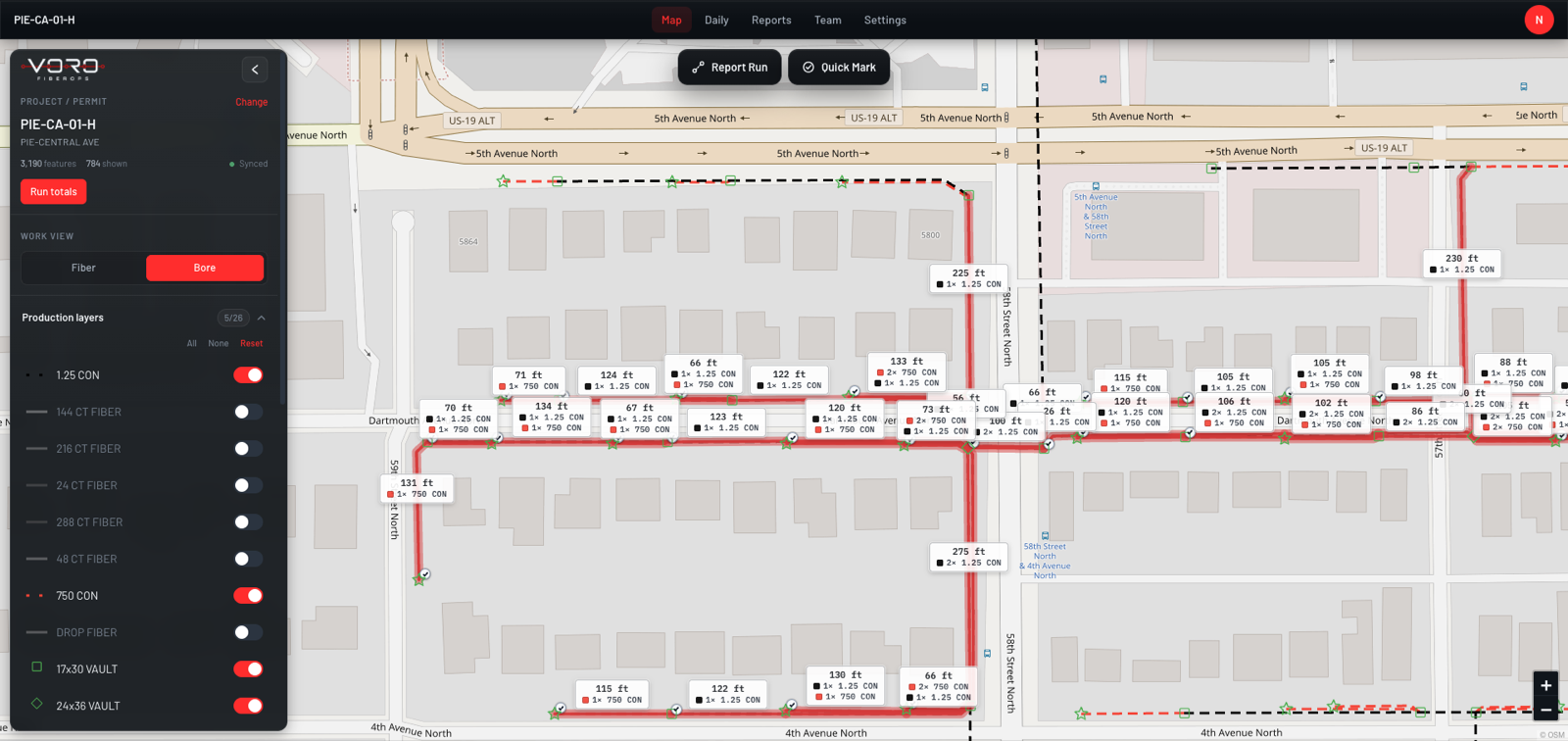
Voro FiberOps is a map-based production tracking platform for underground fiber contractors. It uses a live fiber map as the visual layer and lets crews log completed work directly against the plan, then turns that work into production reports and an invoice-ready weekly package.
It is deliberately not a GIS tool and not a mapping replacement. The map is how the field team finds the work. The product is tracking what got done and generating the reports the contractor is paid on. The headline number everywhere is total footage completed, the unit fiber crews are paid on. The Voro FiberOps product page walks through the full workflow.
The Problem
Before Voro, production tracking for a fiber build was spread across a stack of disconnected steps. The work was getting done well in the field, but recording it, reporting it, and billing for it was slow, repetitive, and easy to get wrong.
- PDF redlines marked up by hand
- Footage measured and re-measured manually
- Handwritten production records
- Production tracked across disconnected spreadsheets
- The same calculations repeated every week
- Crew communication scattered across texts and calls
- Slow, end-of-week production reporting
- Difficult, error-prone invoice preparation
- Limited production visibility for the contractor
- Errors from duplicate or unclear map data
Product Strategy
Rather than build another generic construction dashboard, I built the system around the real contractor workflow. The product follows the same path the work does: a crew opens a plan, finds the run or structure they completed, and logs it with the footage, date, notes, and photos.
Every screen is organized around total footage completed because that is the number the business runs on. That single decision shaped the map, the dashboard, the reports, and the invoice package, so the data a crew captures in the field flows straight through to the number the contractor bills. The how it works page follows that same path end to end.
Map-Based Production Tracking
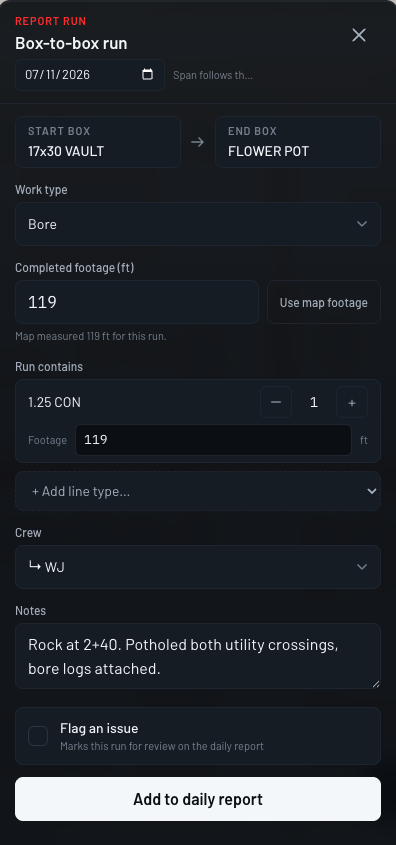
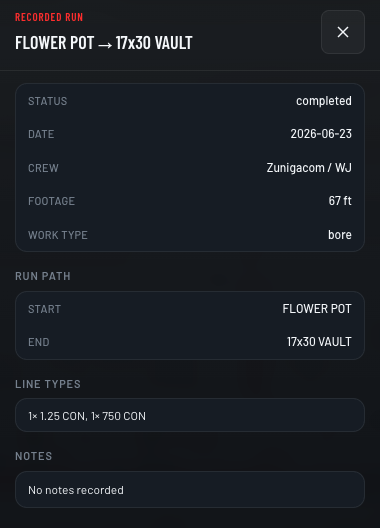
The core of the application is a full-screen fiber map. A crew taps a run, a box-to-box span such as flower pot to flower pot or vault to vault, or an individual structure, and logs the completed work against it. The interface pulls the measured footage from the map so the field team can confirm it instead of calculating it by hand.
Work type, line types, conduit counts, crew, notes, and an issue flag are all captured in the same place, so a single tap turns finished field work into a structured record.
VETRO and GIS Integration
Voro reads the fiber plan directly from VETRO as a read-only mapping source, so crews work against the same authoritative map the project is designed in. I built the integration layer to normalize that map data and render it cleanly, then handle the practical realities of a third-party GIS API such as rate limits and cached plan metadata.
Production data lives in its own store, completely separate from VETRO. Voro never edits the GIS. It layers a production workflow on top of it, which keeps the source of truth intact while giving the contractor a system built for tracking and reporting.
Workflow Automation and Data Accuracy
Once a run is logged, Voro handles the math. Footage and conduit calculations that crews used to repeat by hand every week are done automatically and consistently, and the platform surfaces unclear or duplicate map data so it gets resolved instead of quietly inflating a report.
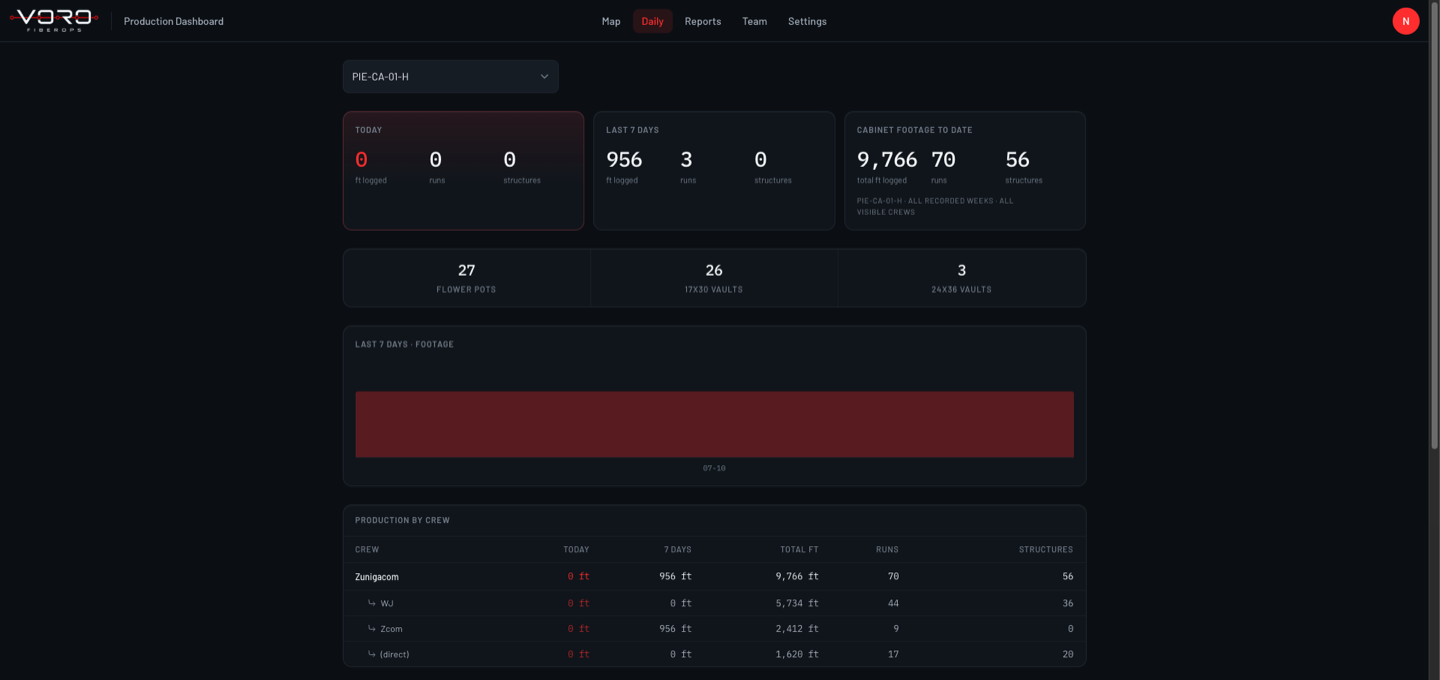
The result is a cleaner production record with fewer reporting errors, and an owner view that shows production across every crew in real time instead of at the end of the week. The solutions page maps these outcomes to each role on a crew.
Production Reporting and Invoicing
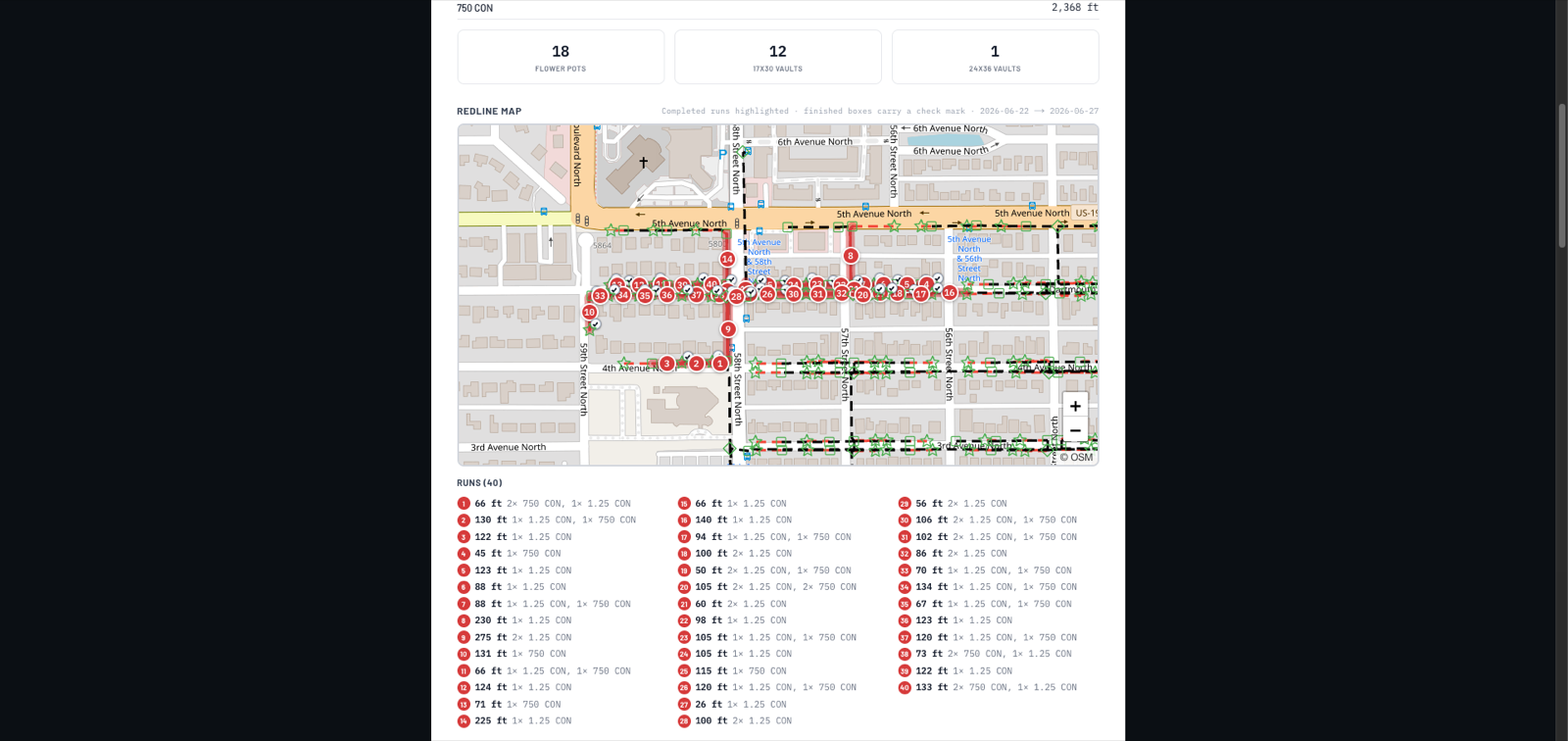
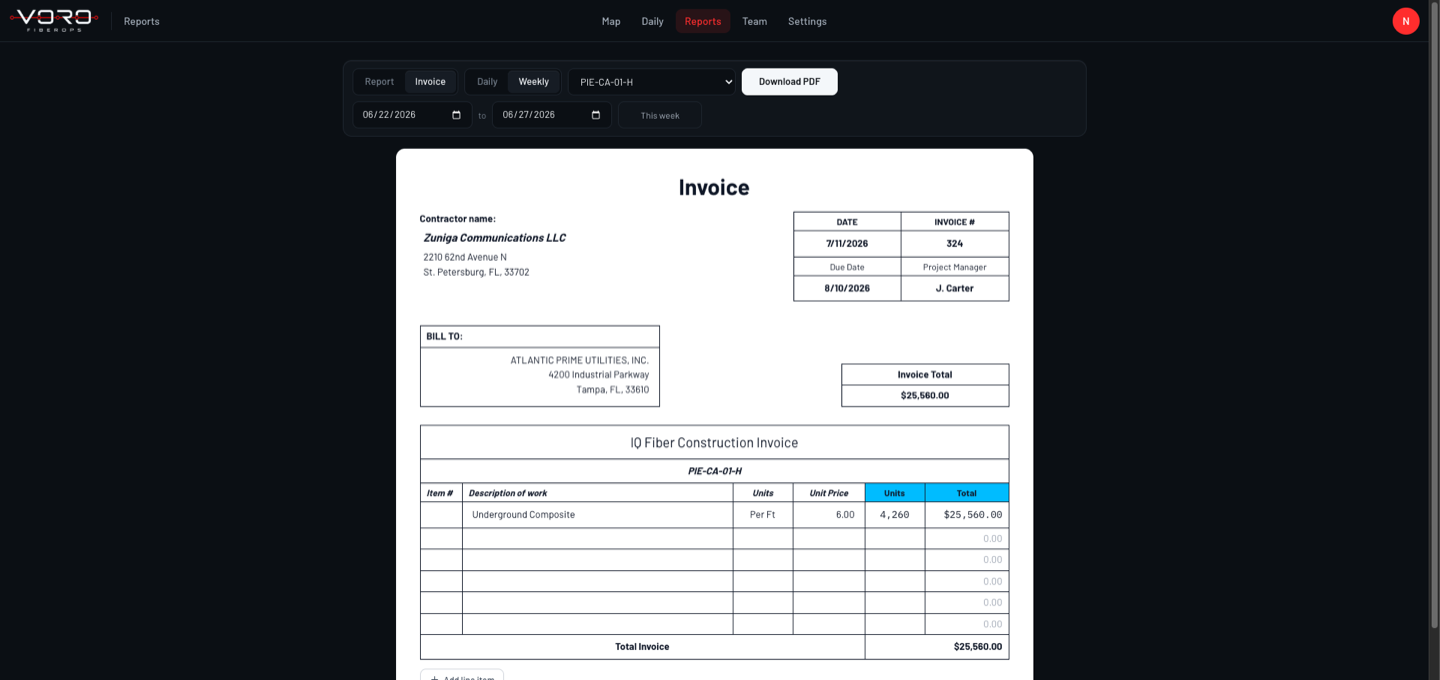
Voro generates daily and weekly reports from the same logged work. Each report assembles a redline map with completed runs highlighted, a footage summary, and breakdowns by structure type and by crew and day, all exportable to PDF.
The weekly report is the invoice support package. Because it is built from the footage crews already logged, invoice preparation that used to be a manual, error-prone task becomes a direct output of the work itself.
Access, Security, and Language
Every account is scoped to a company, and access is role-based across admin, crew lead, crew member, and viewer roles, so an owner sees the whole operation while a crew sees the work in front of them. I built the security and billing controls around that structure.
Because fiber crews are often bilingual, Voro ships with full English and Spanish support. The interface resolves a crew member's language before the first screen paints, so the app is usable in the field in the language the team actually works in.
AI-Assisted Development and AI-Ready Architecture
Voro is not an AI product today, and I have been careful not to position it as one. AI showed up in two honest ways.
First, I used AI-assisted development to move faster across research, coding, testing, debugging, documentation, and iteration, which let one person design and build a platform of this scope.
Second, the way the production data is structured creates a foundation for future AI-assisted features. Because every run and structure is captured as clean, consistent data, the architecture can later support intelligent discrepancy detection, reporting, and project summaries without reworking the core system.
Marketing Website and Brand
Alongside the application I developed the product brand and the public marketing website. The site explains the product to contractors, recreates the interface in the real Voro brand, and includes a reporting-workload estimator and a demo request flow.
The brand carries through both surfaces, from the Carbon and Signal Red identity to the map-first product language, so the marketing site and the application read as one product. The company page tells the story behind why I built it.
Outcome
Voro FiberOps replaces a fragmented mix of PDF redlines, manual footage math, and disconnected spreadsheets with a single system built around the field workflow. Completed production becomes organized records the moment it is logged, which cuts the repetitive administrative work at the end of every week and reduces the reporting errors that come with re-entering the same numbers by hand. The savings estimator lets a contractor put numbers to that manual reporting time.
Owners get live visibility into production across every crew, reporting comes straight out of the logged work, and the weekly package is ready to support an invoice. It is a complete product I conceived, designed, and built, from the field workflow and integration layer through to the marketing website.
- A private map-based production tracking application
- A read-only VETRO and GIS integration layer
- Run and structure footage logging tied to the plan
- Automated footage and conduit calculations
- Daily and weekly production reporting
- Weekly redline package built for invoicing
- Role-based company and crew access controls
- English and Spanish support
- Security and billing controls
- A public marketing website and product brand
See Voro FiberOps
A map-based production tracking platform I built for underground fiber contractors, turning completed field work into organized records, reports, and invoice-ready packages.
Conceived, designed, and developed by Nicholas Grande, Founder and Product Developer.